
Sisyphus, MD.
How humanity’s pursuit of healthy years must evolve from treating individual diseases to building the infrastructure needed to target aging itself.


Longevity initiatives are not unique to our time. The underlying urge towards health and life endures from era to era, but its practical target is shaped around the epidemiological burdens of its time. Today, that thing is age-related diseases and frailty1. But in the early twentieth century, when infectious disease was the biggest thief of healthy years, public advocates of public health argued that lengthening American life meant securing “pure milk, pure water, pure air.”2
Irving Fisher, at the time one of America’s most prominent economists, knew that thief well. Tuberculosis, the disease that killed his father, forced the economist to spend the first three years of his Yale professorship on leave in sanatoria. The illness re-oriented his priorities, turning public health and life extension into a personal cause. As a member of the Committee of 100 on National Health,3 Fisher wrote “National Vitality: Its Wastes and Conservation” for the National Conservation Commission, created by Theodore Roosevelt. There, he gave this project of national vitality conservation an epidemiological target:
Eighty-five per cent of deaths by typhoid fever are unnecessary. […] It would be feasible to prevent at least 75 per cent of cases of tuberculosis of the lungs. […] These seven diseases alone could easily be reduced by these amounts […] simply through insistence by the public on pure milk, pure water, pure air, and reasonable protection from accidents.
Alleviating those diseases, by his estimation, would raise average life expectancy from roughly forty-five years toward sixty, a gain a contemporary digest headlined “Lengthening Human Life In This Country One-Third”:
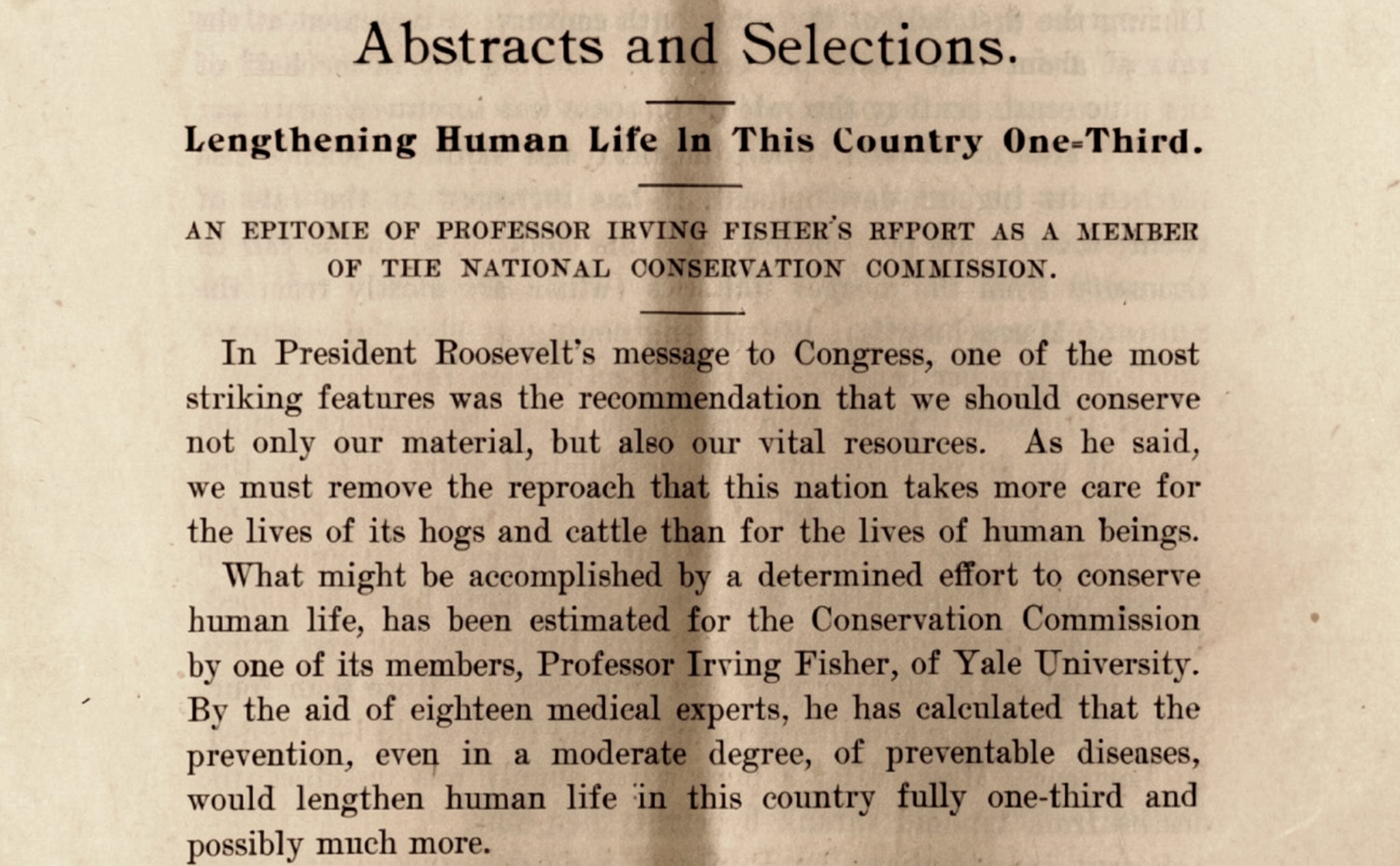
In December 1913, Fisher went on to co-found the Life Extension Institute, and its supporters showed how well the idea had been received. William Howard Taft, fresh out of his US presidential term, chaired its board. Irving Fisher chaired its Hygiene Reference Board and co-wrote its manual “How to Live,” and its consultant on sanitation was William Crawford Gorgas, the army doctor who eliminated yellow fever and brought malaria under control in Panama. William Welch, the founding dean at Johns Hopkins, lent his name too, as did New York’s health commissioner Hermann Biggs. The Institute called itself a body devoted to “the great war of civilization against needless sickness and premature death.”
Over a few decades, the urge was reduced to practice. We began to chlorinate water, whose safety could be judged by bacterial cultures instead of by our senses, and started pasteurizing milk (https://doi.org/10.2307/2173395). Then came therapeutics that could go after the infectious agents themselves once they had entered the body. Sulfonamide antibiotics, the first effective treatment for several bacterial infections, cut mortality by an estimated 2-3% while adding somewhere between 0.4 and 0.7 years to life expectancy (source). Penicillin followed, as did streptomycin, the first antibiotic against tuberculosis. Although the smallpox vaccine had existed since 1796, the disease killed an estimated 300 million people in the twentieth century alone until sustained vaccination campaigns and global coordination eradicated the disease in 1980.
We have done remarkably well in our war against infectious disease, and the gains in lifespan have far exceeded Fisher’s expectations. In the United States, life expectancy rose from 47.3 years in 1900 to 78.7 years in 2018. The Institute itself bears witness that longevity was already sought as a public good, though in those days the chief enemy was infectious disease; and when that enemy receded, another was revealed behind it: the diseases of aging, and they became the new limit upon longevity.
Who is our new enemy?
In the US, more than three quarters of deaths now occur after age 65, and almost a third after age 85. Of the top ten causes of death most are chronic diseases, and together they account for somewhat less than two thirds of deaths4. Among the diseases that form the backdrop of later life — neurodegenerative and metabolic syndromes, cardiovascular disease, and the majority of cancers — the greatest risk factor is aging itself.
We’ve responded to these diseases by directing biomedical research and drug development towards new medicines. Statins and antihypertensives have driven a long decline in cardiovascular mortality, and smoking cessation and cancer screening have lowered cancer deaths. Such victories against high-burden, common age-related diseases is obviously very desirable: A treatment for Alzheimer’s, for example, could produce enormous population-wide gains in quality of life. Yet even a win that large would ultimately struggle against the ceiling imposed by late-life chronic disease, accumulating year after year as we age.
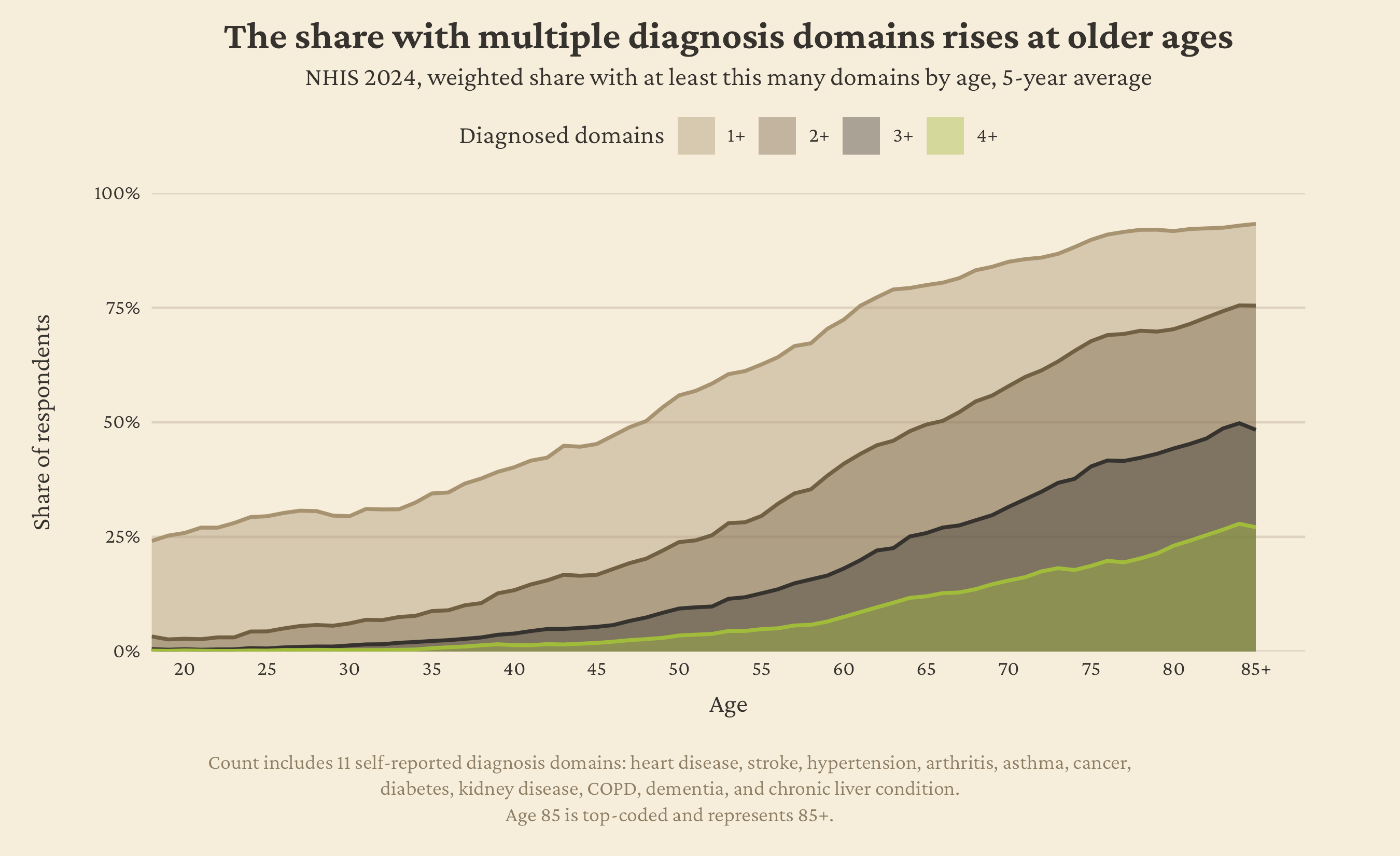
By age 65, ~half of people have at least two chronic diseases. By 85+, three quarters do, and the share with four or more rises from minuscule to over a quarter of the 85+ population5. Curing diseases of aging one by one will yield important but unremarkable lifespan returns, because late-life disease is a network of competing risks that becomes increasingly intricate as we age. Take one away, or even two, and you are soon in the grips of the next. If pancreatic cancer vanished, people would still live only as long as their remaining, and newly accumulating, chronic diseases allowed them to6.
This kind of Sisyphean medicine is destined to leave most old people less-but-still sick. Longevity science presents an alternative, and goes far beyond basic research on how aging happens: it aims to discover interventions that may change the course of later life by altering the ways our bodies break over time, and seeks also to broaden the kinds of medicine that can be carried forward into drug development.
A bed for one crop
What kinds of medicines is longevity science working towards, then? As nicely taxonomized by Karl Pfleger, these run from broadly slowing aging by turning its rate down, to divide-and-conquer rejuvenation where accumulated damage is reversed one subpathology at a time. Around those sit smaller sub-fields, like replacing parts of the aging body wholesale.
But coming up with ideas for longevity interventions is only part of the field’s task. We also need to figure out how to test them in humans. This is necessary, but difficult, because these broader approaches to longevity medicine require infrastructure that is less mature, like clinical trial designs suitable for measuring frailty, less legible, or even nonexistent, like measurements that could serve as surrogate endpoints for future mortality. This pushes sponsors to slot longevity drugs into single-disease indications where risk legibility is highest. But trials designed around a single disease are not best suited to show a longevity drug’s broader potential benefits, which handicaps returns for longevity medicine.
These field-specific sources of translation risk sit on top of the already daunting odds that shape investment throughout drug development. This is especially true for non-incumbent sponsors, who have weaker priors about trial design and regulatory perception. Even a drug that works can disappoint commercially if it does not beat cheap, familiar care well enough to justify adoption.
Of all these risks, the most consequential is clinical trials. Trial economics matter enormously: they consume most of the capital a biotech raises, and further distort the search for multimorbidity drugs, because cleaner efficacy signals are easier to produce in narrower patient populations. Sponsors are therefore pushed to slot longevity drugs into increasingly narrow indications7. Once a drug wins approval for one condition, it can usually expand to only a few others before exclusivity expires; but from there, pharma has little incentive to keep sponsoring trials for it.
Longevity drugs, like anything new, therefore carry greater scientific and commercial risk than drugs in more established fields of medicine, and are pushed by biotech and pharma to conform to the narrower indications common in those fields, where uncertainty is easier to contain.
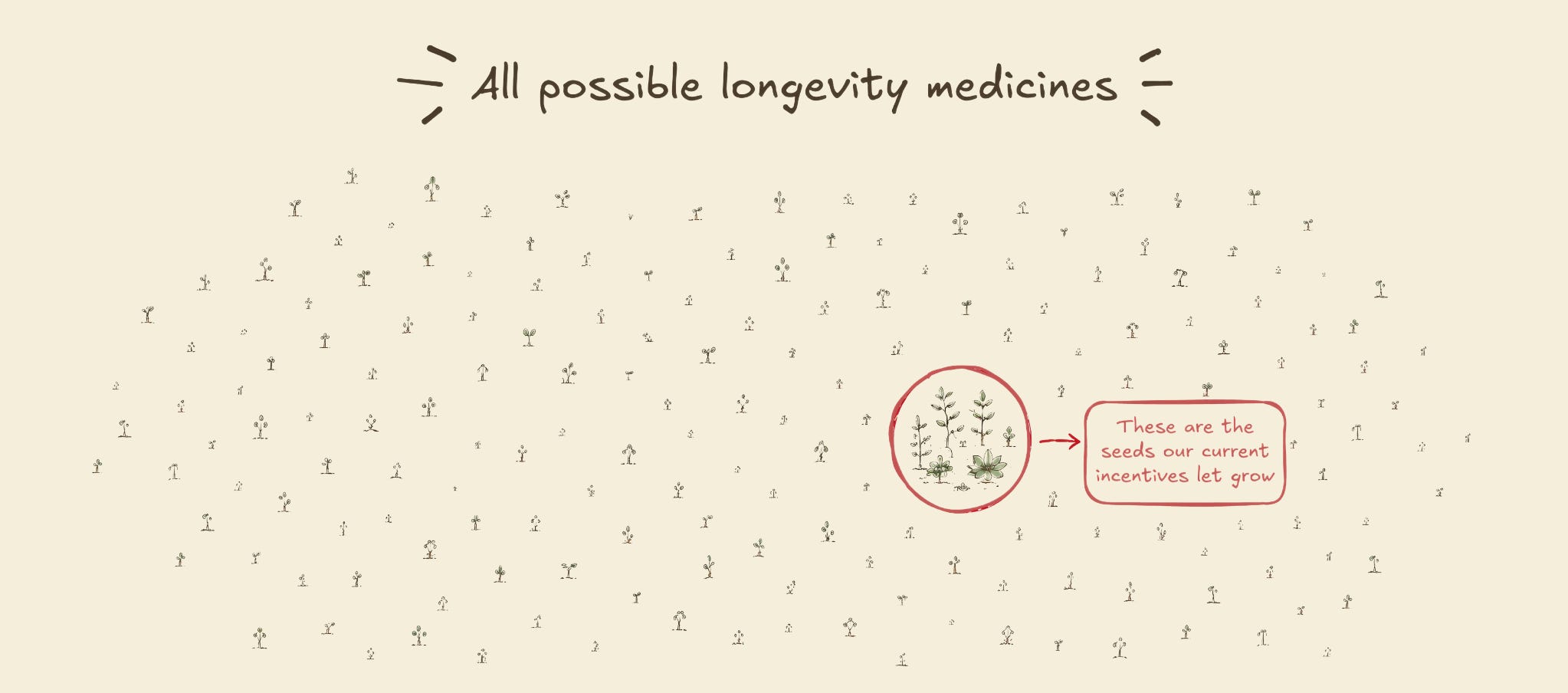
Put differently, the field is being grown in soil prepared for one type of crop. The current seedbed gives regulatory and market support to single-indication candidates. Other interventions need different soil, where benefit is expected to appear in forms our current infrastructural, market and regulatory gates do not provide strong incentives for. A seed can look weak when the soil was never prepared for that plant.
Building longevity drugs like we built antibiotics
The longevity field is still small and young, without routes of its own for developing drugs that alter age-related decline. It therefore relies on drug-development machinery built around conventional disease indications, creating the conflicts described above. What would longevity-specific infrastructure look like? One that turns every advance into a foundation for enriching the next? And what could the field become once it exists?
Take antibiotics as an example. There was a time when each antibiotic was a single, isolated, and largely serendipitous discovery, in the way that exploratory research often is. Bacitracin emerged from Columbia researchers’ study of the microbial ecology of contaminated wounds; cephalosporin from a University of Cagliari professor’s investigation into why sewage-contaminated seawater was not producing the disease outbreaks he expected. But it became an industry when we figured out how to make each discovery and infrastructural innovation the ground for the next one. Once germ theory took hold in the second half of the nineteenth century, sanitation and medicine acquired a new, legible object of intervention: the pathogen. Then came techniques such as pure culture and viable plate count for bacterial enumeration, which made it possible to attribute an effect to a defined organism and measure its response to intervention. Bacteria had become, at last, tractable.
That tractability gave us methods of discovery that any laboratory could use to take antibiotic research from craft into mass production, as in Waksman’s program, which systematically screened thousands of soil microbes for activity against pathogens and gave us streptomycin and neomycin. Drug companies took note of that success and built soil-screening programmes of their own, helping launch a burst in which we discovered most of the major antibiotic classes derived from microbes. For a while, dirt was an extraordinarily productive pharmaceutical platform.
And then we learned how to make vastly more of these drugs. We figured out how to coax greater yields of penicillin out of better molds and increasingly optimized growth media, and eventually moved the entire enterprise into deep-tank fermentation8. This industrial system became more cumulative still as quality signals at each stage made improvement legible and comparable. We established the Oxford unit, and later the International Unit so laboratories and manufacturers could compare penicillin potency across batches and production sites. We also coordinated our wartime agencies so that improvements developed by one company could spread to others. Then we made the road from the laboratory and the factory to the market and common use, first by randomized clinical trials and later by requiring that a treatment prove its efficacy.
Together, our advances in discovering and producing those drugs compounded into the golden era of antibiotics that ran from the 1940s into the 1960s.
Longevity has not yet found its versions of the soil screen or the penicillin unit, advances that allowed antibiotics to become an industry by letting researchers test interventions at scale and learn from fast, validated readouts. Earlier in discovery, molecular biomarkers of aging could provide those readouts, de-risking new interventions by increasing the speed of discovery and identifying likely responders, once validated for specific uses. But no such measure exists yet, as we’ve argued before. At the clinical end, it needs a path to proof that can formalize and accelerate trials without reducing aging to a single disease. Some routes are emerging here: a multimorbidity composite endpoint like in the aging trial design we proposed asks whether a candidate aging drug can delay the first instance of an age-related disease event. A functional endpoint asks instead whether a candidate drug preserves mobility, frailty, or intrinsic capacity — a composite measure of a person’s total mental and physical abilities — without waiting for a named disease. ARPA-H’s PROSPR program is currently trying to validate intrinsic capacity as an FDA-approved functional endpoint for aging.
For now, the single-disease indication remains longevity’s only established route through drug development, leaving many broader hypotheses about aging without a viable path to human trials. Optimism, meanwhile, is gathering. Silver Linings models how large gains from even modest progress could be, while longer and healthier lives seem to attract more serious attention as a medical frontier among researchers and economists alike. Expanding how we develop and test drugs to match that ambition will be essential to human flourishing.

The truth-seeking portions of it, at least.
Page 633.
Possibly its president — at least he was in 1911, based on this source.
The eight are heart disease, cancer, stroke, chronic lower respiratory diseases, Alzheimer’s disease, diabetes (aging #2 risk after diet), kidney disease, and chronic liver disease/cirrhosis. The other two are injury-related (which are more lethal with age).
Depicted in the graph. Sample is U.S. sample adults age 18+, weighted with SAMPWEIGHT; n = 32,312 after requiring complete responses across all counted domains, representing about 257.6 million adults. Curves show the weighted share with at least 1, 2, 3, or 4 diagnosed domains, so the bands are cumulative rather than mutually exclusive.
For scale: one model by the Jay Olshansky lab projected that reducing heart-disease incidence by 25% would add 0.8 years of remaining life expectancy, while cutting cancer incidence across the population by 25% would add 1.1 years. This figure covers cancer broadly, not any single cancer such as pancreatic cancer. Broadly delaying aging added 2.2 years, most of them in good health.
Another contributor to this phenomenon is the orphan-drug designation, which has helped turn narrow indications into commercially attractive niches.
 | A guest post by
|
One question stays open even if the endpoint turns out to be a good one.
Validation asks whether a measure can detect an intervention already known to work. The panel it gets characterized against is built from interventions that were funded and run, and the clock essay makes that route explicit, testing responsiveness against the ways we already know how to modulate aging in mice.
Adoption runs the relationship the other way. Once a trial can be built around the score, the interventions it detects well become the easier ones to finance, and those are the trials that produce the next round of data, which characterizes the score further around the same family. How strongly this pulls depends on trial costs and on what else is available to serve as an outcome.
Public benchmarking settles who does the scoring. Who assembles the panel is a different question.